
The Plans Available to You And What You Can Still Do This Year
As a business owner, planning for retirement is one of the most consequential financial decisions you'll make, not just for your own future security, but for your ability to attract and retain the talented people who help your business grow. This newsletter launches a new series we're dedicating entirely to retirement plans for business owners. Our goal is simple: cut through the complexity, give you the information you actually need, and help you take action before the windows close. And right now, with just a few months left in 2026, there are still meaningful opportunities available. Which plan is right for your business? The answer depends on your business size, how much you want to contribute, how much administrative burden you're willing to manage, and whether you want employees to participate alongside you. Here are the most common plans.
SEP IRA
The Simplified Employee Pension IRA is exactly what its name suggests — a simplified, employer funded retirement account that gives business owners a straightforward path to large, tax-deductible contributions. The employer contributes directly into a SEP IRA for themselves and for any eligible employees. There are no employee deferrals, no nondiscrimination testing, no Form 5500 to file, and no annual compliance requirements to speak of. You open it, contribute when you want, and that's it.
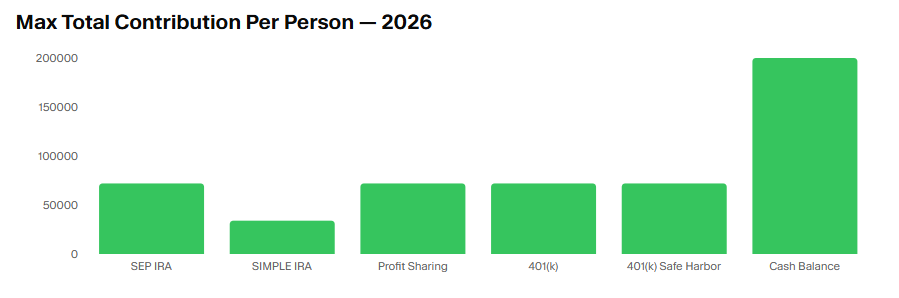
The numbers: In 2026, you can contribute up to 25% of eligible compensation or $72,000 per person, whichever is less. The compensation cap is $360,000. Contributions are entirely discretionary, meaning you can contribute the maximum in a great year and nothing at all in a difficult one.
The catch:
Contributions must be the same percentage of compensation for every eligible employee as you contribute for yourself. For a solo business owner or a business with very few employees, this is a non-issue. For a business with a larger workforce, it can make the SEP IRA expensive.
SIMPLE IRA
The Savings Incentive Match Plan for Employees IRA is designed specifically for small businesses with 100 or fewer employees. Unlike the SEP IRA, the SIMPLE IRA allows both the employer and employees to contribute. Employees elect a deferral amount from their paycheck and the employer is required to contribute on top of that. The employer contribution is mandatory, and you choose between two formulas:
- Match option: Match 100% of employee deferrals up to 3% of their compensation (can be reduced to 1% in two out of every five years)
- Non-elective option: Contribute 2% of compensation for all eligible employees, whether they contribute or not.
The numbers:
In 2026, employees can defer up to $17,000, with a catch-up of $4,000 for ages 50–59 and 64+, and $5,250 for ages 60–63. Total employee and employer amounts will vary based on each participant's compensation and the employer's chosen contribution formula.
The strengths:
Minimal administration, no Form 5500 required, no nondiscrimination testing, and a mandatory match that encourages employees to participate and save. The required employer contribution is also fully tax-deductible.
The limitations:
The employee deferral limits are lower with a SIMPLE IRA than any other retirement plan. Employer contributions are mandatory every year — there's no skipping a year if business is slow. And a SIMPLE IRA cannot be maintained alongside any other qualified retirement plan.
401(k)
The 401(k) is the most widely recognized employer-sponsored retirement plan. It combines the highest employee deferral limits of any defined contribution plan with maximum employer flexibility, plan design customization, and the ability to serve businesses of virtually any size. In a 401(k), employees elect to defer a portion of their paycheck pre-tax (or to a Roth account after-tax), and the employer has the option, but not the obligation, to contribute a match or profit sharing contribution on top of that. The employer contribution formula is entirely up to the plan document.
The numbers:
In 2026, employees can defer up to $24,500, with a catch-up of $8,000 for ages 50–59 and 64+, and $11,250 for ages 60–63 (the "super catch-up" introduced by SECURE 2.0). Total contributions from all sources — employee deferrals plus employer contributions, are capped at $72,000 per person (or $80,000/$83,250 with catch-up contributions).
SECURE 2.0 Roth catch up rule:
Beginning January 1, 2026, participants age 50 or older who earned more than $150,000 in FICA wages from the plan-sponsoring employer in the prior year are required to make all catch-up contributions on a Roth (after-tax) basis. Pre-tax contributions up to the standard $24,500 limit are still permitted — but any catch-up amount above that must go into a Roth account. If your plan does not currently offer a Roth option, high-earning participants will be ineligible to make catch-up contributions until one is added. This is a significant change for business owners and highly compensated employees who have historically relied on pre-tax catch-up contributions to reduce current-year taxable income.
The strengths:
Highest contribution limits of any defined contribution plan. Maximum flexibility in plan design. Allows both Roth and traditional contributions. Participant loans available. Vesting schedules available for employer contributions.
The complexity: Traditional 401(k) plans are subject to nondiscrimination testing which compare how much highly compensated employees (including owners) defer relative to lower-paid employees. More administrative overhead than a SEP or SIMPLE IRA. Requires a Third-Party Administrator (TPA), annual Form 5500 filing, and ongoing compliance monitoring.
Safe Harbor 401(k)
The Safe Harbor 401(k) solves the nondiscrimination testing problem entirely. For many business owners, that single feature makes it the most valuable plan structure available. In a traditional 401(k), the amount owners and highly compensated employees can defer is constrained each year by how much rank-and-file employees participate. If lower-paid employees don't contribute enough, the plan fails its ADP/ACP tests and owners may be forced to take refunds on their contributions, sometimes after the year is already over. The Safe Harbor 401(k) eliminates that risk entirely. In exchange for making a mandatory employer contribution, the plan is automatically deemed to satisfy ADP and ACP nondiscrimination testing, allowing owners and highly compensated employees to contribute the full $24,500 deferral limit (plus catch-ups) without restriction.
With the mandatory employer contribution, you have two options:
- Safe Harbor Match: Match 100% of employee deferrals on the first 3% of compensation, plus 50% of the next 2% — for a maximum match of 4% of compensation. Alternatively, an enhanced match of at least 100% of deferrals up to 4% of compensation also qualifies.
- Safe Harbor Non-Elective: Contribute 3% of compensation for all eligible employees, regardless of whether they contribute anything themselves.
Both contributions are immediately 100% vested, which is a key distinction from a traditional 401(k) where employer contributions can be subject to a vesting schedule.
Adding Profit Sharing: A Safe Harbor 401(k) can also include a discretionary profit sharing component. This allows the business to make additional employer contributions in years when cash flow allows. Profit sharing is completely flexible: you can contribute the maximum in a strong year and nothing at all in a lean one. When paired with Safe Harbor, this creates the most powerful combination available in a defined contribution plan.
Defined Benefit Cash Balance Plan
The three plans above are all "defined contribution" plans, meaning the contributions are defined and the eventual retirement benefit depends on investment performance. A Defined Benefit (DB) plan works in reverse: the benefit at retirement is defined, and contributions are actuarially determined to fund that promised benefit. In a Defined Benefit plan, the employer bears the investment risk. If markets underperform, the employer must contribute more to make up the shortfall. In a 401(k) or SEP IRA, the employee bears that risk.
The numbers: For 2026, the maximum annual retirement benefit that can be funded through a Defined Benefit plan is $290,000 per year. The annual contribution required to fund that benefit is actuarially determined based on the participant's age, years until retirement, and investment return assumptions.
The strengths: Unparalleled tax deduction potential for high-income owners, especially those age 45–60. Predictable benefit for employees. Can be layered on top of a profit sharing/401(k) plan for maximum contribution.
The complexity: Requires an enrolled actuary every year to certify the contribution and the plan's funded status. The contribution is mandatory, not discretionary. Highest administrative cost of any plan type. Not suitable for businesses with significant numbers of younger employees.
Each plan offers a distinct trade-off between contribution limits, administrative complexity, and employer obligation. This makes the right choice entirely dependent on your business size, workforce, and income goals. See the comparison chart below for a side-by-side breakdown of each plan's 2026 contribution limits.
What Can You Still Set Up for the 2026 Tax Year?
The SIMPLE IRA and the Safe Harbor 401(k) discussed in this newsletter must be established by October 1 to allow employee deferrals for the 2026 plan year. That window has now closed for 2026. Both remain excellent options to set up now for 2027, and we'd encourage any business owner interested in either structure to start that conversation soon.
For 2026, several options remain on the table. A traditional 401(k) can be established by December 31 to allow employee deferrals this year, with employer contributions made as late as your tax return due date, including extensions. SEP IRAs, Solo 401(k)s, and Cash Balance plans are even more flexible: all three can generally be established and funded by your business tax return due date, meaning you can technically wait until after the year closes to act. One note on Cash Balance plans: while setup is flexible, the required annual contribution is generally due by September 15 of the following year, so funding has its own calendar regardless of when you open the plan.
If you've been thinking about setting up a retirement plan, or upgrading the one you have, the fall is the ideal time to start for 2027. Getting a plan established before January 1st means you and your employees can begin contributing from the very first paycheck of the year, maximizing the time your money has to grow. It also means you won't be rushed into a decision, stuck scrambling against a deadline, or forced to settle for a plan structure that isn't the best fit for your situation. Establishing a retirement plan is one of those decisions that is easy to postpone and difficult to regret. It rarely feels urgent, until a deadline passes or a high-income year goes by unsheltered. Yet the business owners who get this right are rarely those with the most elaborate strategy; they are simply the ones who acted while the opportunity was still available. If anything here raised a question or if you're unsure which plan fits your business, we'd be glad to help.
This newsletter is for educational purposes only and does not constitute tax, legal, or investment advice. Please consult a qualified tax advisor, ERISA attorney, and financial professional before implementing any retirement plan or strategy. Contribution limits and tax figures referenced are for the 2026 tax year.

The Right Retirement Plan Can Change Everything, But Only If You Have One

Trump Accounts: Benefits, Tradeoffs, and Where They Fit

Make the Most of Your IRA and HSA Contributions Before Tax Day

Dividing Retirement Accounts After Divorce: 5 Tax Mistakes to Avoid for a More Secure Retirement

How to Choose the Right Financial Advisor: 5 Steps to Finding Your Best-Fit Advisor

What Adults With Student Loans Should Understand About Planning for Retirement

How to Build an Income Ladder Without Chasing Yield

Jump-Start Your Financial Health This January: A Practical Guide to Getting Back on Track

Step-Up in Basis: How Heirs May Reduce Capital Gains

The First Five Years of Retirement: Taxes, Withdrawals, and Benefits

Asset Location 101: Improve After-Tax Returns Across Accounts

RMD Sequencing: Lower Taxes and Avoid Penalties
Understanding 2026 Tax Brackets and Strategic Planning

Should You Claim at 62, 67, or 70? A Timing Guide

Medigap vs. Medicare Advantage: Costs, Networks, and Tradeoffs

Don’t Let Outdated Beneficiaries Derail Your Estate Plan

Open Enrollment Checklist for North Houston Retirees

Fall Into Good Financial Practices For A Strong Year End

One Big Beautiful Bill Act: What You Need to Know

End the Year Strong: 4 Key Financial Moves to Consider

National Annuity Awareness: Securing Your Future

Social Security Fairness Act: What Retirees Need to Know
Read more
Timing is Key: Understanding RMDs in a Market Slump

2025 Update: New Rules for Inherited IRAs

Understanding Risk Tolerance for Smarter Investments

Understanding Tax Benefits and Implications of Homeownership

Exploring Charitable Giving Options for Maximum Impact
Read more
Key Considerations for Roth Conversions

Navigating Missed RMDs: A Step-By-Step Approach
Read more
Understanding Risk Tolerance for Smarter Investments